

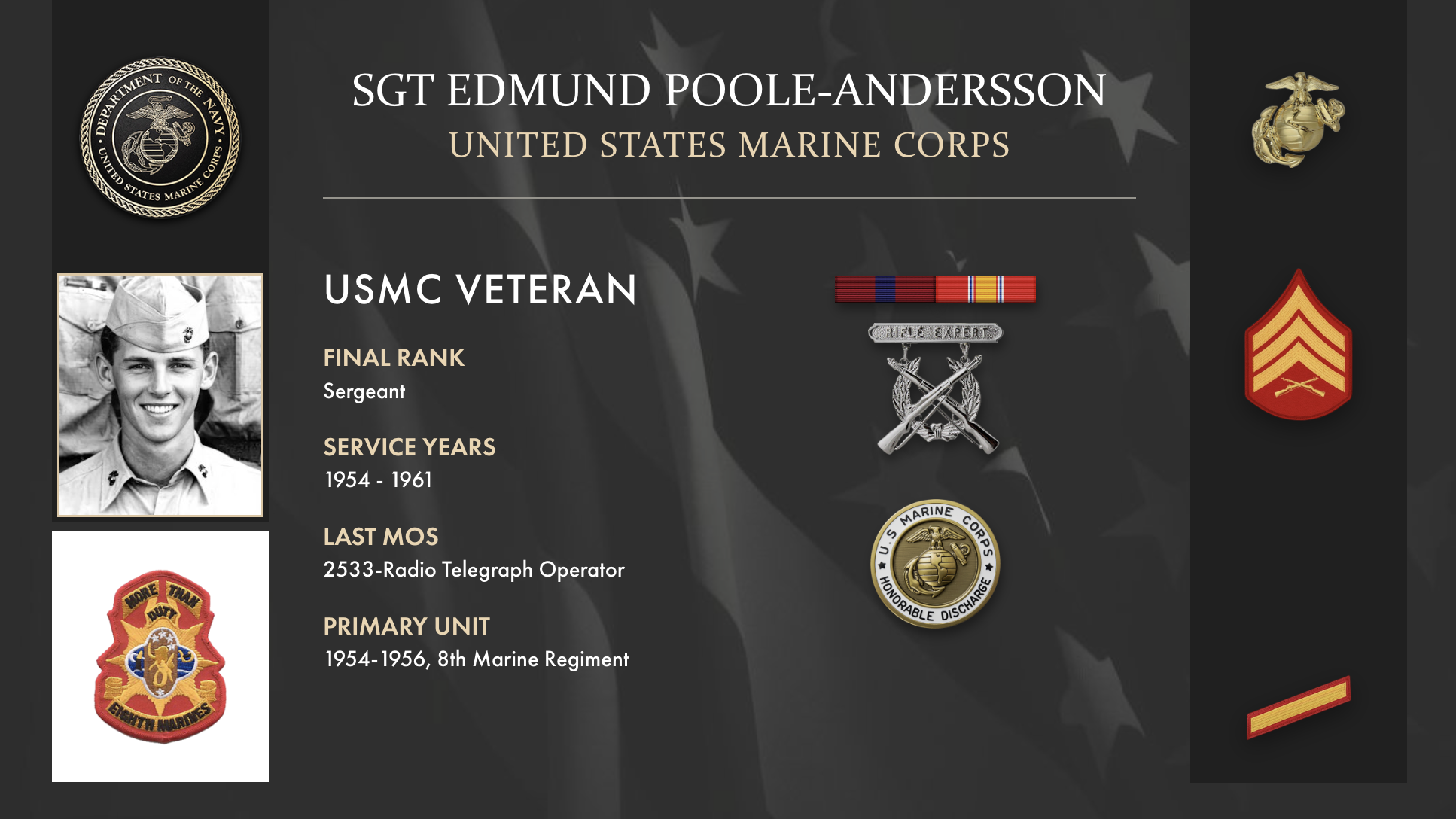
PRESERVING A MILITARY LEGACY FOR FUTURE GENERATIONS
The following Reflections represents Sgt Edmund Poole-Andersson’s legacy of his military service from 1954 to 1961. If you are a Veteran, consider preserving a record of your own military service, including your memories and photographs, on Togetherweserved.com (TWS), the leading archive of living military history. The following Service Reflections is an easy-to-complete self-interview, located on your TWS Military Service Page, which enables you to remember key people and events from your military service and the impact they made on your life. Start recording your own Military Memories HERE.
Please describe who or what influenced your decision to join the Marine Corps.
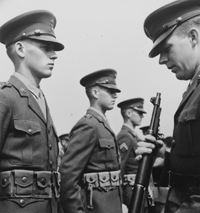
I grew up an adopted child in a dysfunctional family and was compelled to leave home at age 16. I managed to finish high school while paying for room and board earned from working two part-time jobs.
In 1953, at age 17, I joined the Army National Guard (Combat Engineers, Charlestown, MA) to earn extra money and its drill team for the same reason, getting my first taste of military service. I was Captain of my high school hockey team, earned league All-Star honors, but had a passing but unimpressive academic record. Playing at the college level required remediation in prep school, which was unaffordable. So, I decided to test myself in the Marine Corps, a better option than the projected path that lay ahead. That decision changed my life!
Whether you were in the service for several years or as a career, please describe the direction or path you took. Where did you go to boot camp, and what units, bases, ships, or squadrons were you assigned to? What was your reason for leaving?

I credit the Marine Corps for creating the person I became. I authored a memoir, “Finding Me, an adoptee’s lifelong search for family and identity, which tells my story. The Corps boosted my self-confidence, strengthened my innate capabilities, and elevated my goals for the future. If I were an officer, I might have made the Corps a career. My goal was to further my education under the G.I. Bill upon separation and see where it took me.
If you participated in any military operations, including combat, humanitarian, and peacekeeping operations, please describe those that made a lasting impact on you and, if life-changing, in what way?
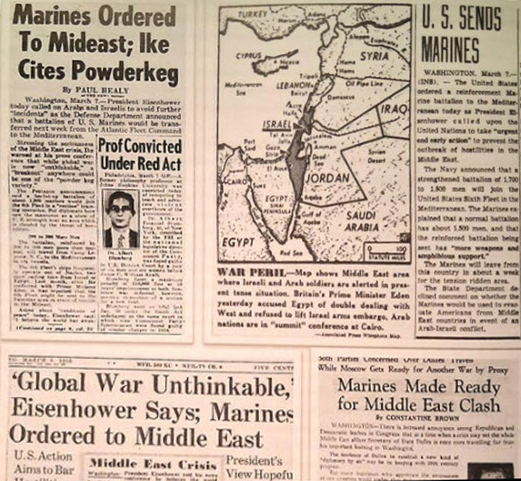
When Eisenhower ordered our deployment to the Middle East in 1954, we had no idea what lay ahead. Our destination wasn’t revealed until we entered the Straits of Gibraltar. That deployment was a display of saber-rattling in support of Israel and the British and French in their recapture of the Suez Canal. And then there was the Hungarian Revolution. It was a volatile period of proxy war between the East and the West that seems to have escaped history. The 6th Fleet and our presence were credited with cooling tensions in the area, and we were spared combat. We were relieved after taking on contaminated water in Turkey, which negatively impacted our entire six-ship task force. Our relief unit rescued American citizens from Beirut, a place made infamous in the Corps’ history in 1983. A Marine without combat experience is a self-conscious one. I rationalize that by knowing that we were there, ready and able to uphold the traditions of the Corps if called upon. I served at the end of the Korean Conflict, and my eight-year obligation ended prior to Vietnam. I consider myself a very lucky man.
Of all your duty stations or assignments, which one do you have fondest memories of and why? Which was your least favorite?
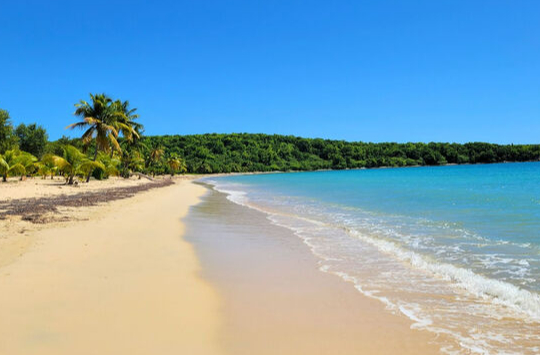
Best: With the 8th Marines spending the winter of 1955 on the Island of Vieques, PR, it was a great experience. Living in 6-man tents, eating C-rations, and taking cold showers was offset by beautiful white sandy beaches, towering palm trees, and sparkling turquoise water. Chesty was CG of the 2ndMarDiv then, and he came down to spend some time with the troops. I viewed this experience as the best “bonding” one I encountered in the Corps. Our units grew very close, and the Corps gave us ample time to recreate at that base.
Least Good: “Make work” time at Camp Lejeune! With a communications MOS, there was hardly any daily routine for the MOS. Lots of boring time sitting around doing nothing. Work details and boredom aptly describe that duty.
From your entire military service, describe any memories you still reflect on to this day.
While at Vieques, cooking evening C-rations over Sterno cans, one of our guys (dumbly) used an empty Sterno can, sand soaked in a little gasoline, as a cooking heat source. Thinking his fire was out, he began to add some fuel from a 5-gallon gas can. It ignited instantly. In his panic, gas spilled all over him in the process. He was a human torch! It took several of us to get him to the ground and douse the flames that engulfed him. The aftermath was horrible! Burned from head to foot, he was medevaced to a San Juan hospital and then back to the States. The sight and smell still linger in my brain.
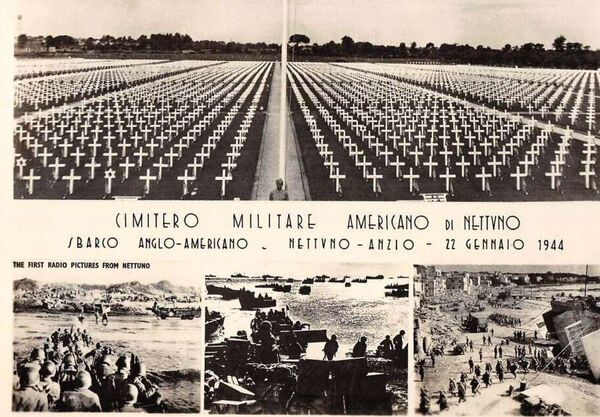
I was tasked with supporting the Allied Flyover at the dedication of the Anzio Cemetery near Rome. While that sounds straightforward, getting it done was not. My involvement, although minor, took some yeoman work from the 6th Fleet and Monrovia deckhands. While anchored in Naples Harbor in the summer of 1956, I was summoned to our flagship, the USS Intrepid. There, I received orders for the task occurring a few days later. My radio jeep, stored below in a hold under one of the Marine sleeping bays, had to be retrieved, brought topside, then lowered below into a Mike boat for transport ashore. That meant hundreds of grunts would be without sleeping racks until I returned!
Curiosity of “what the hell is going on” was shouted at me after I reached the loaded jeep. I simply replied, I’m going to Anzio! Alone and armed with an Italian road map, I made my way to the cemetery with little time to spare! Nervously awaiting my arrival were several ranking officers decked out in full formal attire. My nerves were on edge, too. My Jeep radio was unreliable. Our tech Sgt. gave me a portable backup and recommended we use it. The Anzio OIC gave me permission to do so, without asking why, and things went smoothly. I had another reason to get out of there quickly, so off I went. Returning to Naples harbor and getting resettled aboard the Monrovia went like clockwork. The Monrovia’s crew was outstanding and old hands at doing this stuff. The Marine grunts took it in stride and got squared away before dark.
That experience emphasized the cost of poor tactical leadership in the number of lives lost. The story is infamous, leading to the shameful firing of an Army General in the field. The cemetery is exemplary in its design and superb quality, befitting those who were laid to rest there, far from home. I was honored to play a small role in that ceremony.
What professional achievements are you most proud of from your military career?
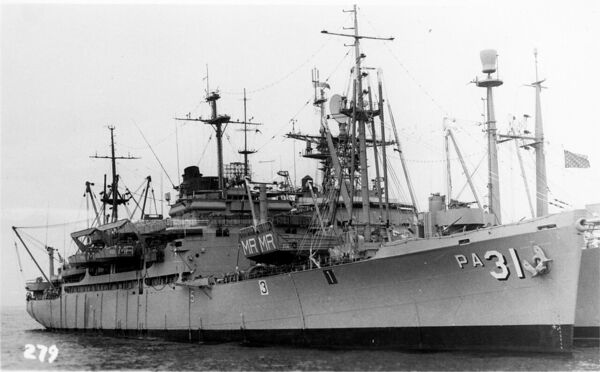
I believe my experience aboard the USS Monrovia made me a top-tier Radioman. In the field, Marines use voice transmissions as much as possible. At night, atmospheric conditions demand Morse Code, which had more range and reliability. In those days, at sea and amongst the fleet, most communications traffic was Morse code. It’s a very challenging task that demands focus, speed, and accuracy. Evidence of my skill level came unexpectedly one night from network control–then the carrier, USS Intrepid. When the network controller has to take a break for one reason or another, he has to assign control to another operator on the network. He assigned that task to me (obviously not knowing I was a Marine)! To this day, I wonder if a Marine was ever given that responsibility in the fleet. It may seem minor, but I view it still as a wonderful compliment.
Of all the medals, awards, formal presentations and qualification badges you received, or other memorabilia, which one is the most meaningful to you and why?
The Corps, during my service, was not big on awards. (I see rows of ribbons today that are subordinate to the National Defense Ribbon, and I wonder what they’re for.) Even promotion testing back then was basically infantry-centric. I don’t ever recall a test–outside of radio school–that measured MOS competence. In the FMF, you did what was expected, and that was that. I’m proud of my Rifle Expert badge. I’m proud of my MOS expertise. I’m proud of helping save a brother Marine’s life. I’m proud to have served on a deployment that may have prevented a world war. I’m proud of being chosen as a leader of my peers. But I have the most pride in earning the title, U.S. Marine!
Which individual(s) from your time in the military stand out as having the most positive impact on you and why?
I revered the returning Marines from Korea when I joined the FMF. Those guys were heroes to me. I was lucky enough to become friends with many of them. Their sea stories were honest ones and left an indelible impression on me of what a Marine is. The pomp and circumstance are great, but the core of the Corps is the individual Marine who puts it all on the line wearing the EGA, not the guy in Dress Blues. Sgt. Joe Gillen, from Boston, had his arm nearly blown off by an enemy grenade in the trenches of Korea, treated me like a kid brother. And serving under “the Chesty Puller” was a privilege and an honor for me.
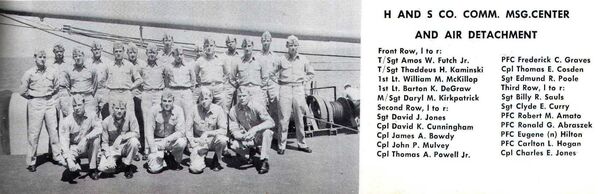
While deployed, our Close Air Support team was under the command of two 1stLt fighter pilots. Both were doing required career duty with grunts on the ground. Lt. Bart DeGraw, the senior officer, was a fine officer and had the respect of our entire crew. While at sea, he and I had many private conversations that helped guide my future beyond the Corps.
List the names of old friends you served with, at which locations, and recount what you remember most about them. Indicate those you are already in touch with and those you would like to contact.
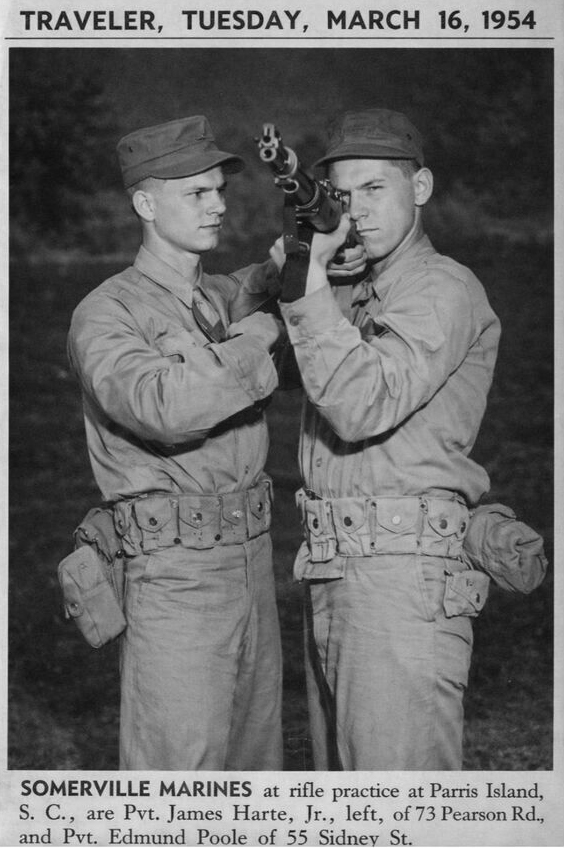
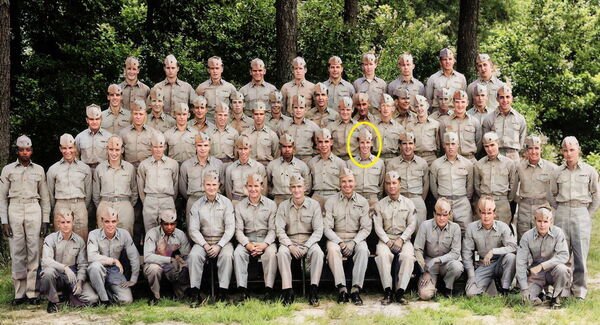
Most of my contemporaries are gone. I enlisted in Jan. 1954 with two hockey teammates in response to a “Go to boot camp with your buddy” recruiting campaign. We comprised the “All Boston” Platoon 66, with a few boots from other states. That made for a sometimes-colorful experience under the command of an SDI from the South! In 1959, a group of those Boston-area Marine buddies and I became charter members of a new Marine Corps League Detachment (Charles Shutt Detachment #139), formed in Watertown, MA.
Our other founders were predominantly WWII vets from the Pacific Theater. A couple served with the Raiders. Most were just grunts who fought in various campaigns in the Pacific. That detachment is named after one of the last Marines KIA on Okinawa, where his brother Joe, also a Marine, fought and viewed his brother’s fallen body on that island.
Although some friends died way too soon, such as Jim Harte (see Photo), lifelong friendships followed with many others, in particular with Paul O’Reilly and Joe Tardiff, now both deceased. I may be the last one standing.
Another lifetime Corps buddy is a high school classmate, Ed Vasgerdsian. He did two tours, one with the 6th Marines and another with Embassy Security Guards. He went on to become an actor, with many film and TV credits, and served as a board member of the Screen Actors Guild (SAG). Ed was also a writer for Leatherneck Magazine. One of his more popular tongue-in-cheek pieces was a search for the origin of the phrase “OORAH, which post-dated our service time. His son is the well-known network sports personality, Matt Vasgerdsian (MLB and ESPN).
Another 8th Marine buddy of note is Charles Cioffi, of “Klute” fame (as the psycho killer) and countless film, TV, and stage credits. After the Corps, Chuck studied theater at Michigan and Shakespeare at Stratford-upon-Avon in England. We reunited many years ago after he performed the lead in a Shakespeare production in Boston. My teenage daughters were duly impressed by meeting him at dinner afterwards. Chuck was another who helped save the life of the fire victim mentioned in Vieques.
I believe my long tenure in the Marine Corps League is my recognition of all the great Marines I’ve encountered during my lifetime.
Can you recount a particular incident from your service, which may or may not have been funny at the time, but still makes you laugh?
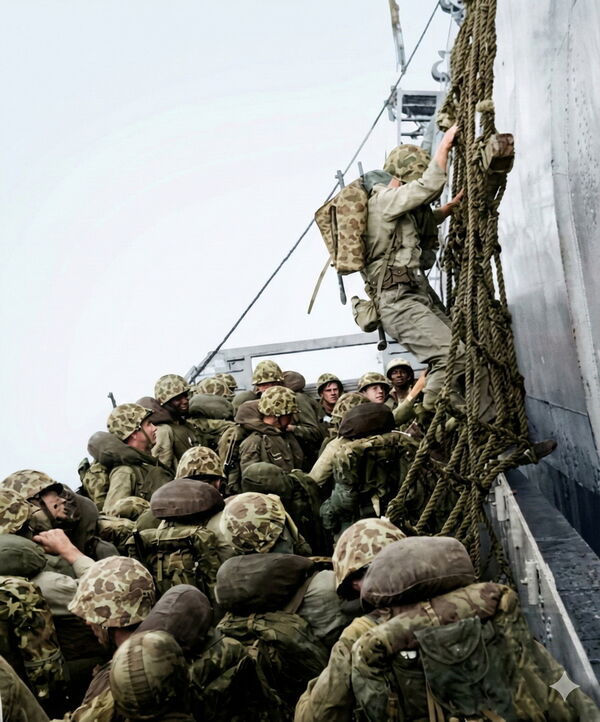
While we were deployed to the Middle East, we had a two-week training exercise in Turkey, which included an amphibious landing and subsequent ground maneuvers. As was the custom then, before returning to our ships, we had a “beach party”. Countless GI cans filled with beer and ice greeted us and were quickly consumed. When the supply was exhausted, we loaded aboard a landing craft and headed to the ships anchored offshore, some fair distance away. My Mike boat was full of drunken Marines laden down in field gear and antique “life jackets”. About midway, the forward ramp collapsed into the sea. If it were not for the quick reaction of the coxswain, who ordered everyone to the stern, we would have sunk. Many lives may have been lost. Getting back aboard the ship required climbing the nets in full combat gear, also a somewhat dangerous task considering the amount of alcohol consumed.
Another. Our six-ship task force was at anchor in Naples Bay in July 1956. The British and French fleets and our flagship, the USS Intrepid, were also there at anchor. The Brits and French were preparing their assault to recapture the Suez Canal. While I was on late watch in the radio shack, scuttlebutt was buzzing about all the noise from sirens and apparent police activity ashore. Soon after, we saw many craft randomly delivering service members from many nations and services to allied ships in the harbor. This sea story has many versions. Mine, from a personal eyewitness account, is the aftermath of a rather large interservice brawl ashore in a popular, crowded bar.
The instigator was allegedly a British sailor who shouted the challenge that the British Navy and Marines could take the Yankee Navy and Marines! To restore peace, orders were given ashore to collect all combatants, put them on any boat available, and send them out to any ships available. The result was a multi-national, multi-service collection of drunks being housed overnight on the anchored vessels. I observed a Marine requesting permission from the OD to board. This guy had bulges under his tropical uniform that were clearly liquor bottles. The OD, understanding the chaos of the night, ordered the Marine to ditch them while he looked the other way. “Aye aye, sir, he replied. The Marine removed both shoes, dropped them overboard, and fled! Hearing two splashes below, the OD turned, smiled, and resumed welcoming people aboard.
Early next morning, over the ship’s comm, the captain ordered “all personnel not assigned to this ship report immediately to the gangway and return to your posts.” A rather large number disembarked.
This will be my last. Nine hundred or so Marines crammed aboard an APA at sea for extended periods can create some mischief, and cruising the eastern Mediterranean in mid-summer can be hot. Two Marines on the fantail got engaged in a “dare bet. while we were underway. One guy dared the other to jump overboard, the prize being a sum of money. We got wind of what was happening when the “man overboard” alarm was sounded. The Monrovia stopped, a gig was quickly lowered, and the rescue crew retrieved the guilty Marine. He may have been saved from the sea, but not the ire of the captain and the penalty of military justice.
What profession did you follow after your military service, and what are you doing now? If you are currently serving, what is your present occupational specialty?
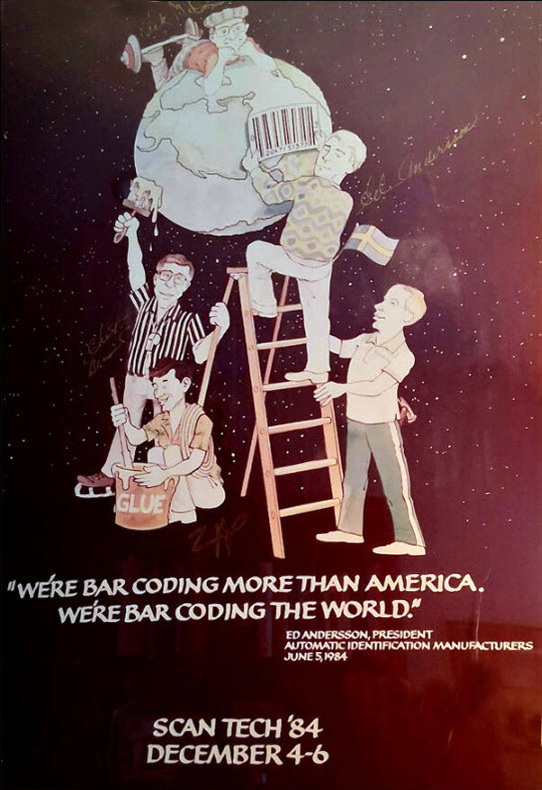
Currently retired. I was a pioneer in the barcode industry (aka Automatic Identification Industry). As VP-International for the first barcode company, Computer Identics Corporation in the Boston area, I represented our company and became a co-founder and first president of AIM Global, Inc., the industry’s worldwide trade association. I was honored as the first recipient of the industry’s highest award, the Richard R. Dilling Award. Previously, I held various communications positions with Avco Missile Systems and the Space Systems Division, and I was a consultant to Avco’s Economic Systems Division program in Boston’s inner city, training and creating jobs for 240 disadvantaged minorities.
What military associations are you a member of, if any? What specific benefits do you derive from your memberships?
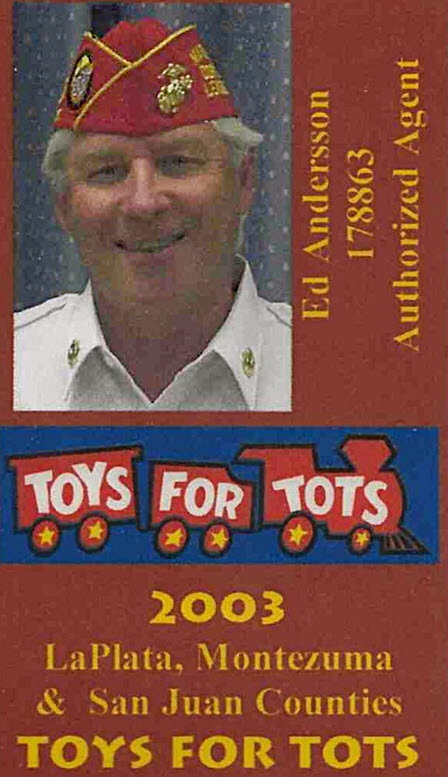
I’m a life member of the Marine Corps League. I’ve held many offices at the detachment and department level, including Commandant. My highest office was Assistant National Vice Commandant of the Rocky Mountain Division, comprising Colorado, New Mexico, Wyoming, & Utah. I’m a charter member of two detachments, one in Massachusetts and the other in Colorado. I was the Marine Toys for Tots Coordinator/Agent for three Colorado counties. I see my participation not as personally beneficial, but more as giving back to the Marine community in the most meaningful way I can. What I gain personally is camaraderie with those I admire most.
In what ways has serving in the military influenced the way you have approached your life and your career? What do you miss most about your time in the service?
Simple: Like the old Sinatra song said: If you can make it here, you can make it anywhere. If you can become a good Marine, you can achieve whatever you want.
Unlike the larger military branches, the Corps delegates leadership to the “next Marine up.” Marines are taught to adapt, innovate, and overcome in all situations. That ethos carries into everyday life. Marine training produces people who are self-confident, accept challenges, and rise to the occasion. That’s uncommon amongst most civilians.
The Corps is the best education you can receive for “life”.
Based on your own experiences, what advice would you give to those who have recently joined the Marine Corps?
You’ve taken the opportunity to see what you’re made of. The results may surprise you. If you leave the Corps, take what you learned with you. If you stay, pass it on.
In what ways has TogetherWeServed.com helped you remember your military service and the friends you served with?
This is a tremendous website. I wish every Marine participated. You document your life in ways your family and descendants may never see otherwise. You reach out to many you served with and perhaps lost touch. In the era of the Internet and social media, I know of no better way to capture and retain the camaraderie we earned and certainly want to retain. Once a Marine, always a Marine!
PRESERVE YOUR OWN SERVICE MEMORIES!
Boot Camp, Units, Combat Operations
Join Togetherweserved.com to Create a Legacy of Your Service
U.S. Marine Corps, U.S. Navy, U.S. Air Force, U.S. Army, U.S. Coast Guard
SHARE:




0 Comments