

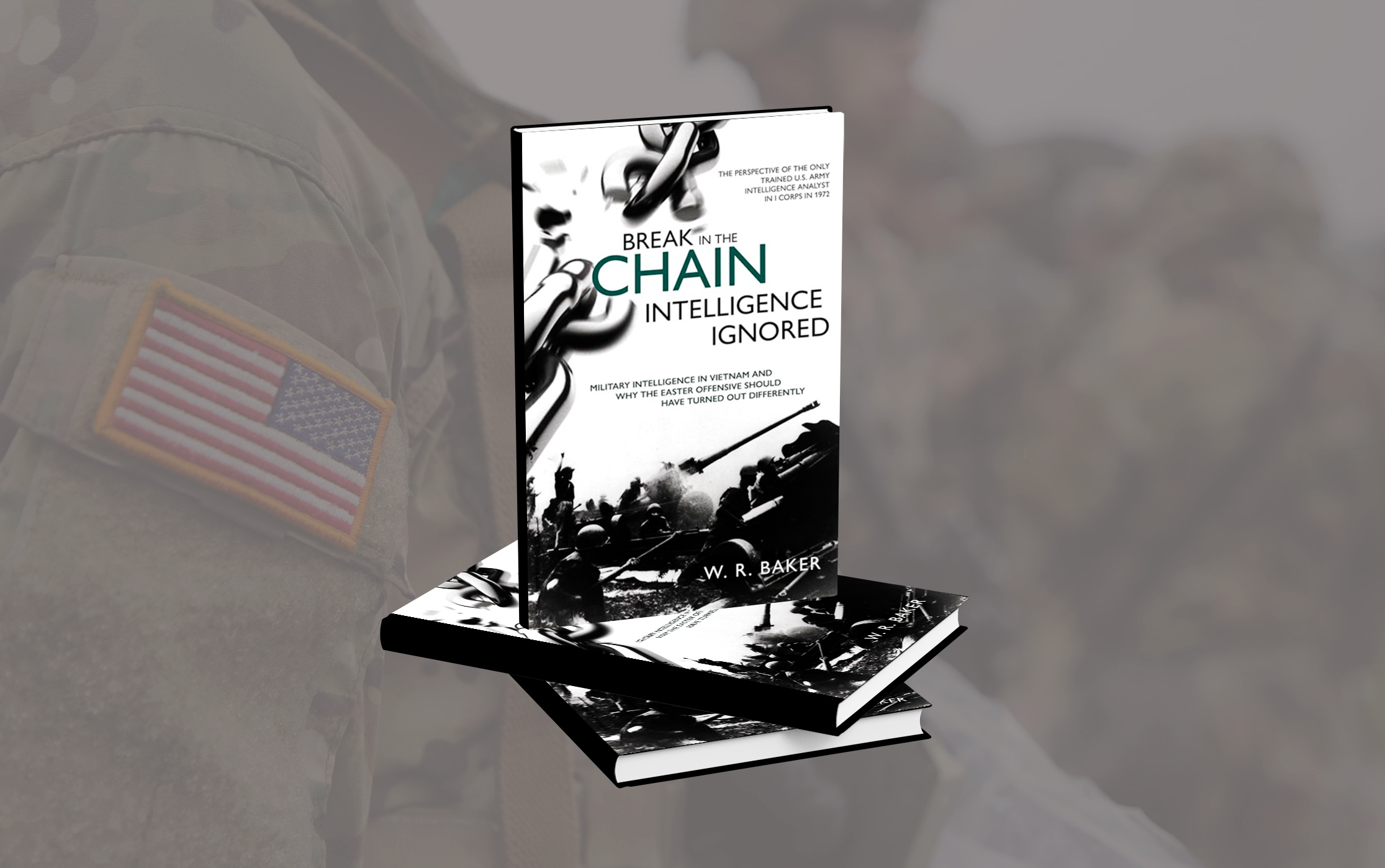
W.R. “Bob” Baker’s “Break in the Chain — Intelligence Ignored: Military Intelligence in Vietnam and Why the Easter Offensive Should Have Turned Out Differently” is both a war story and an indictment. It’s part memoir from the cramped intel bunkers of I Corps in 1972, and part after-action review of how a major enemy offensive can roar through a command system convinced that it “can’t happen here.”
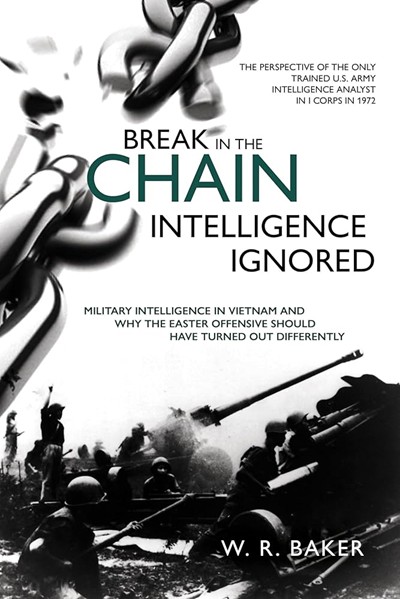
Break in the Chain shows how one analyst made a difference
Baker isn’t an armchair critic parachuting into history decades later. He graduated first in the Army’s inaugural Intelligence (Order of Battle) Analyst course at Fort Huachuca in 1971 and was sent straight to Da Nang, where he became the sole trained intelligence analyst in the 571st Military Intelligence Detachment/525th MI Group, effectively the only U.S. intelligence unit still operating in I Corps at the time of the Easter Offensive.
After Vietnam, he worked as a forward-area watch analyst and electronic order of battle specialist on Syria, Lebanon, Africa’s eastern littoral, Iraq during the Iran–Iraq War, and Poland during the crisis years at the European Defense Analysis Center, earning the Bronze Star, Defense Meritorious Service, Joint Service and Army Commendation Medals. That background gives the book real credibility: this is a technician talking about a system he knows from the inside.
Break in the Chain warns what happens when intel is ignored
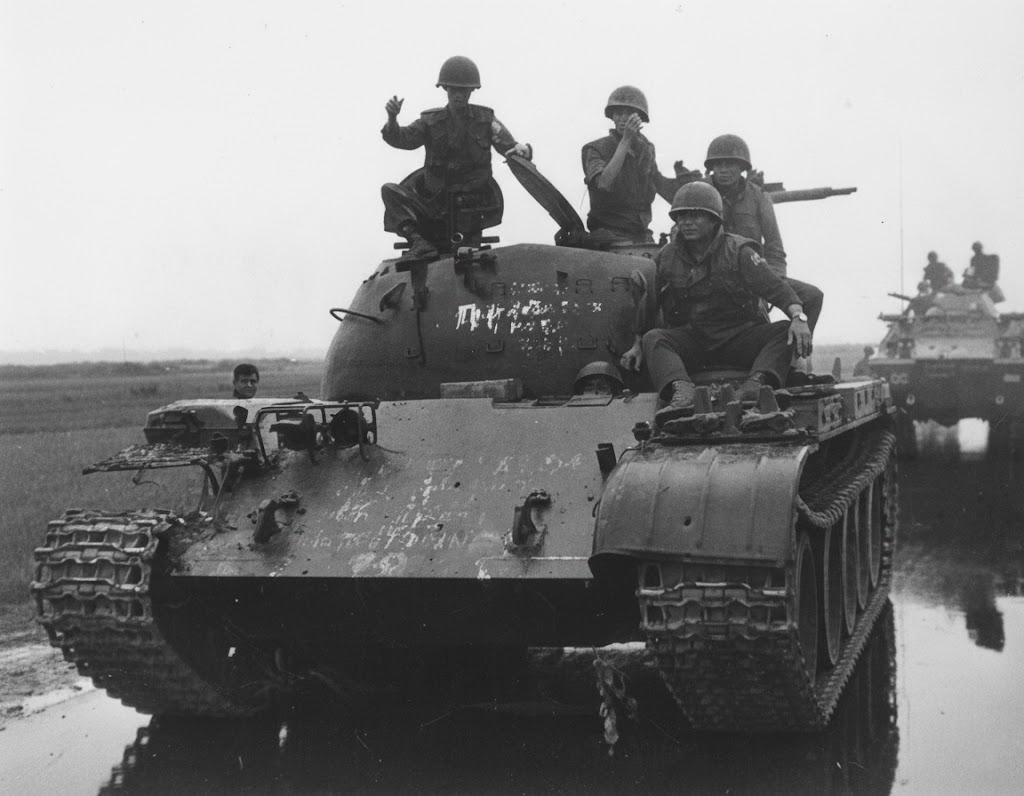
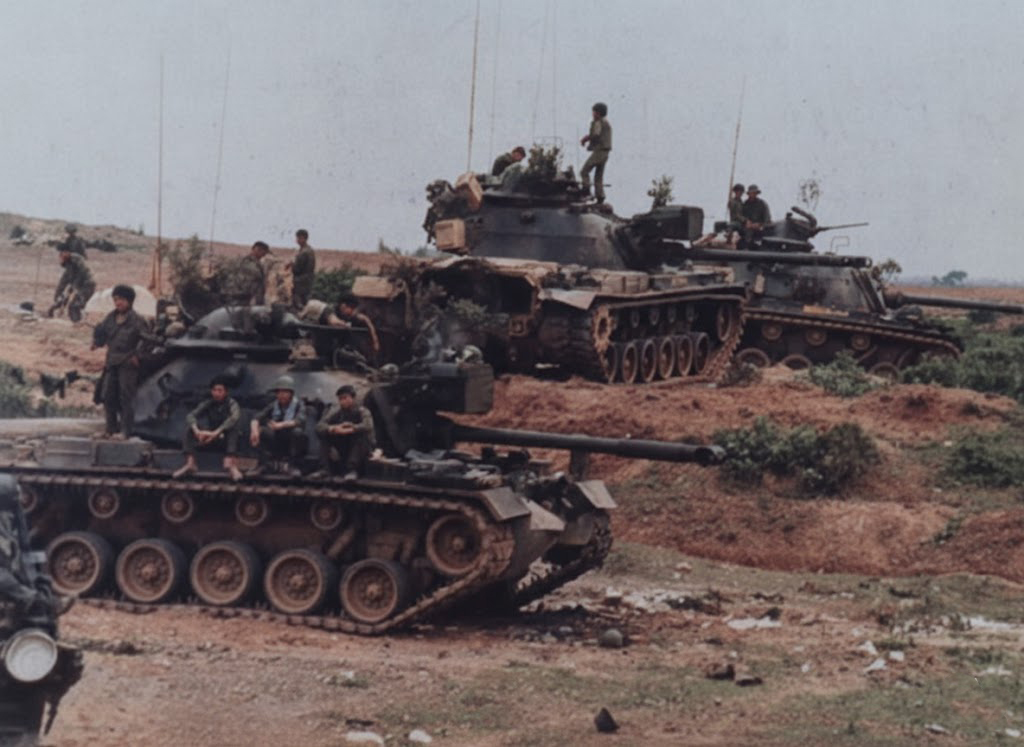
The core of “Break in the Chain” is Baker’s reconstruction of how the 571st Detachment collected and analyzed human and technical intelligence in the months leading up to the 1972 Easter Offensive and how their warnings were shrugged off. He walks the reader through agent reports, order-of-battle changes, and patterns in North Vietnamese movements that, in his telling, clearly signaled a large, armor-supported offensive through I Corps, not a limited Tet-style flare-up elsewhere.

When the offensive finally crashes across the DMZ, the book shifts from “this is what we saw coming” to “this is what it felt like when no one had prepared:” no on-call units to rescue downed aircrew, reconnaissance platoons disbanded, and a command structure improvising under fire.
Break in the Chain proves lessons are ignored at every war
Baker also has an argument, not just a narrative. He explicitly frames Easter ’72 as another entry in the long catalog of ignored-intelligence disasters, comparing the failure to heed his detachment’s reporting to the lead-up to the Battle of the Bulge, Operation Market Garden, and later U.S. missteps in Iraq and Afghanistan.
The book has been praised by reviewers in publications like Military Review, American Intelligence Journal, and Studies in Intelligence as a compact but deeply sourced case study in how staff officers and commanders should (and too often don’t) integrate intelligence into planning.
As a read, it’s surprisingly brisk for what could have been a phone book of acronyms. Baker writes plainly, mixing enough personal detail—being an “Army brat,” living in-country, dealing with personality clashes in the intel world—to keep you anchored, but the real energy is in the reconstruction of the intel picture and the slow, infuriating sense that no one up the chain wants to hear bad news. If you like operations and staff-process detail, it’s catnip.
The only real limitation is that the book is very much the view from one detachment and one professional tribe (intelligence), so South Vietnamese politics, high-level U.S. strategy, and enemy decision-making appear mostly as they refract through his analytic lens. That’s not a flaw so much as a boundary condition: this is a specialist’s brief, not a total history of the Easter Offensive.
Break in the Chain proves expert advice can change outcomes
Overall, “Break in the Chain” is a tight, useful book: essential for intelligence professionals and staff officers, and genuinely illuminating for anyone writing about the late Vietnam War. It’s a reminder that wars don’t just turn on courage or hardware, they also turn on whether the people in charge are willing to listen to the experts in the back room they hired to make these kinds of assessments.
“Break in the Chain—Intelligence Ignored: Military Intelligence in Vietnam and Why the Easter Offensive Should Have Turned Out Differently” by W.R. Baker is available on Kindle and in Hardcover on Amazon, and in hardcover on Abe Books for around $25.
Read About Other Book Reviews
If you enjoyed reading the review of ‘Break in the Chain-Intelligence Ignored’, we invite you to read about other military book reviews on our blog. You will also find profiles in courage, veterans’ service reflections, famous military units and more on the TogetherWeServed.com blog. If you are a veteran, find your military buddies, view historic boot camp photos, build a printable military service plaque, and more on TogetherWeServed.com today.
SHARE:




0 Comments