

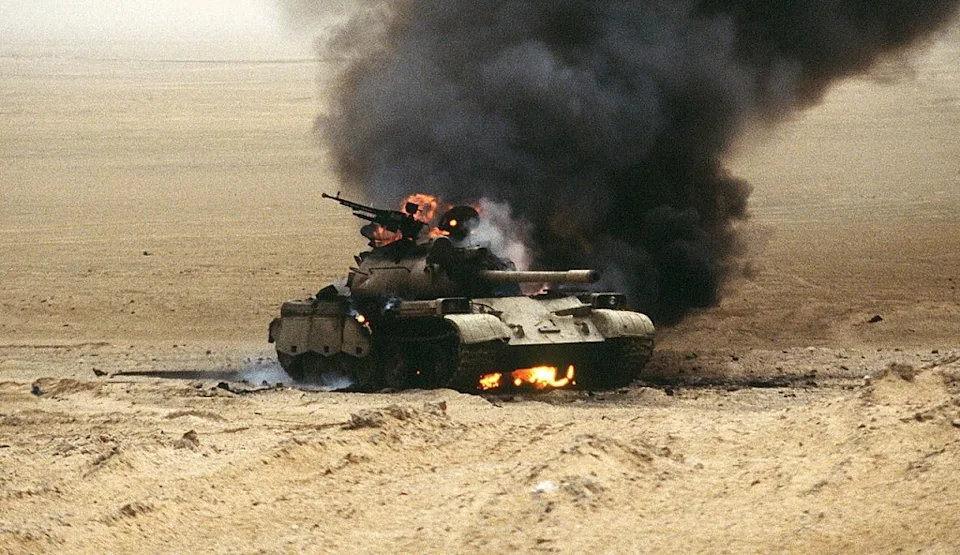
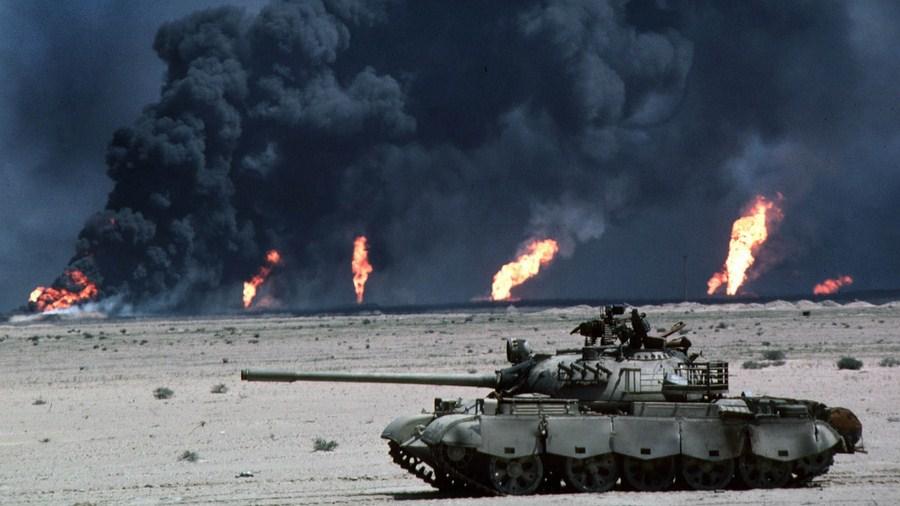
In late February 1991, the desert along the Iraq–Kuwait border was a wholly unremarkable and barren place. There were no towns to name the coming battle; just wind, dust, and a flat horizon marred only by burning oil wells and the silhouettes of armored vehicles.
The Battle of 73 Easting Started as a Map Line
To make sense of that emptiness, coalition planners drew a grid across the map. One of those north–south lines, labeled “73 Easting,” would become shorthand for the last great tank battle of the 20th century. But on the morning of February 26, it was just another imaginary line in the sand.
The battle that formed around it began months earlier, when Saddam Hussein’s invasion of Kuwait triggered Operation Desert Shield, the massive U.S.-led deployment to defend Saudi Arabia and prepare to evict Iraqi forces.
After a 43-day air campaign that wrecked much of Iraq’s command and logistics, Gen. H. Norman Schwarzkopf approved a bold ground plan: a huge, sweeping “left hook” by U.S. VII Corps through the western desert, designed to smash into the Republican Guard from the flank rather than a frontal assault on Iraq’s prepared positions in Kuwait. The Battle of 73 Easting is the moment where Schwarzkopf’s famous hook actually hits the Iraqi army.
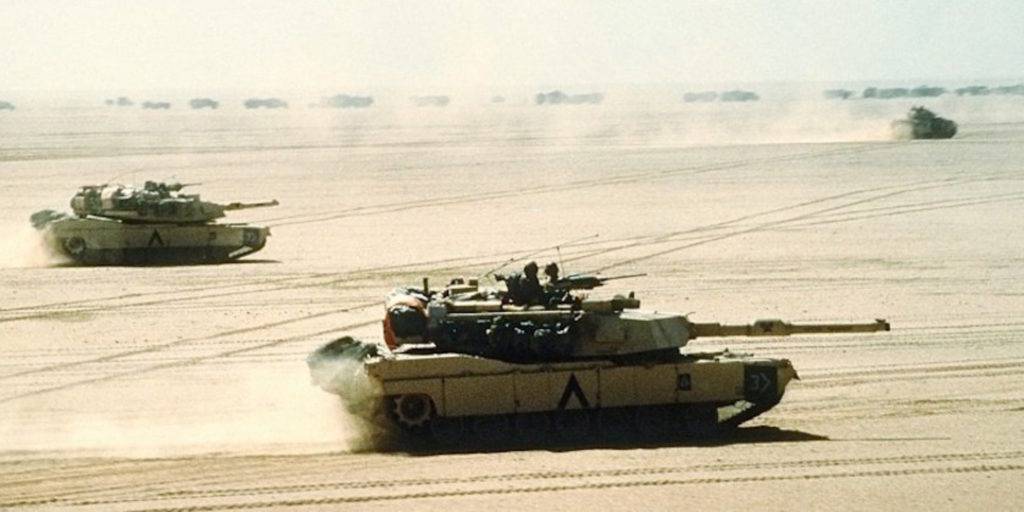
Out in front of that armored fist rode the 2nd Armored Cavalry Regiment, a 4,500-soldier combined-arms cavalry force equipped with M1A1 Abrams tanks and M3 Bradley cavalry fighting vehicles. Its mission was classic dragoon work: move ahead of the 1st Infantry Division, find the enemy’s main positions, fix what it could, and give VII Corps the intelligence it needed before the heavy divisions were fully committed.
The Battle of 73 Easting Intensified with 2nd Cavalry
On February 23–24, the 2nd crossed from Saudi Arabia into Iraq and began its covering-force mission. Progress was cautious at first. Using coarse maps and early GPS receivers to navigate the featureless terrain, the regiment pushed only about 20 kilometers the first day while the divisions closed up behind them. Scouts from F Troop bumped into Iraqi infantry positions and overran them quickly, passing prisoners to following units instead of stopping to process them.
The message from leadership was clear: do not get bogged down in minor engagements and press on until you find the Republican Guard.
By the evening of February 24 and into the next day, the regiment began to see signs that it crossed out of the outer security zone and into the orbit of more capable units. Dusk firefights with better-equipped forces, including a G Troop engagement that destroyed a Republican Guard reconnaissance element, hinted that the elite divisions guarding the approaches to Kuwait were finally ahead of them.
Iraqi officers later confirmed that this area had been used as a training ground, a place where units like the Tawakalna Division had rehearsed live-fire defenses.
The Battle of 73 Easting Hit Full Force at 70 Easting
While the Americans groped forward, the Iraqis were scrambling. Saddam Hussein’s army expected the main assault to come from the south and east; when it became obvious that VII Corps was swinging wide through the west, elements of the Republican Guard and the regular Iraqi 12th Armored Division began to pivot to face the new threat.
One brigade commander, later identified as “Major Mohammed” in U.S. accounts, used his familiarity with a small village and subtle ridgelines in that training area to build a textbook defense. He fortified the village with anti-aircraft guns firing in a ground role and infantry positions, laid minefields to the east, and dug in roughly forty tanks and sixteen BMPs on the far side of a low rise, with another reserve of T-72s about three kilometers farther back. He assumed that any attacker would be tied to the road, funneled straight into his kill zones.
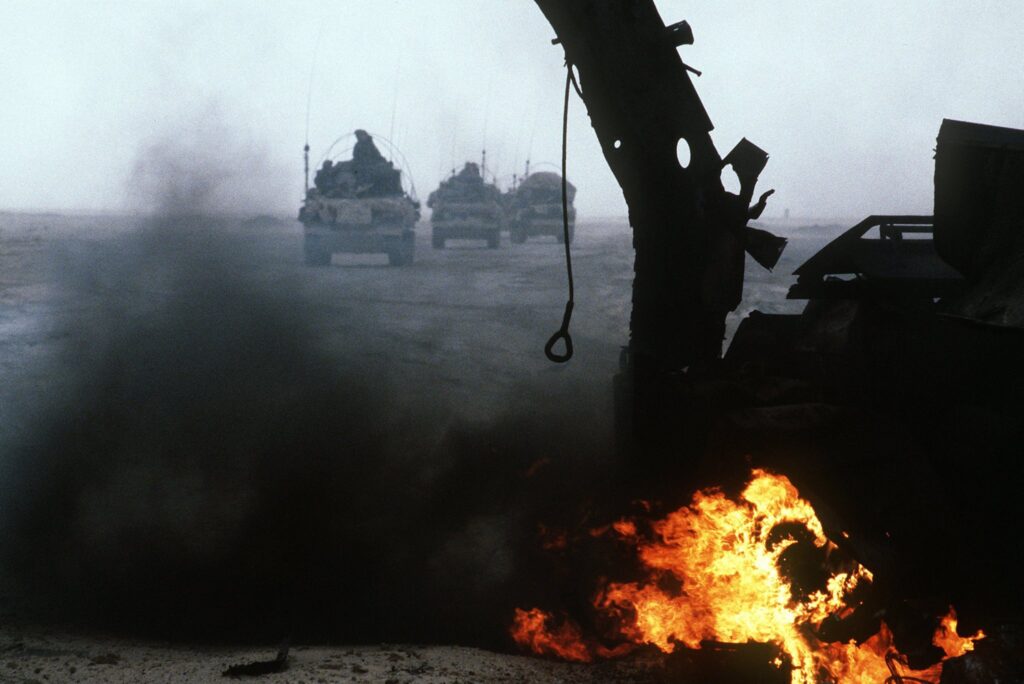
The weather gave him one more ally. On the night of February 25, it rained hard, turning to dense fog on the morning of the 26th; when the fog finally lifted, a shamal, a desert wind that brings intense sandstorms, rolled in, chopping visibility to a few hundred meters. The regiment’s air cavalry was grounded for much of the day, and scarce theater airpower was busy elsewhere.
As one historian put it, the 2nd Armored Cavalry went in “blind,” relying on their own sensors and instincts rather than overhead eyes.
VII Corps shifted its axis of advance from northeast to east, ordering the regiment to drive toward the Republican Guard’s defensive belt. The initial limit of advance was the 60 Easting line, but as the day wore on, corps commanders pushed that limit to 70 Easting to keep the cavalry screen well out in front of the slower, heavier divisions.
By early afternoon on February 26, the 2nd Cavalry was advancing in three squadrons abreast east of Objective Collins, feeling its way through the storm, aware only in general terms that a major Iraqi force lay in wait somewhere ahead.
The first shots of what would be called the Battle of 73 Easting came around the 69 Easting line. As the regiment moved east, one of its units came under fire from a building. The cavalry returned fire and continued to press ahead, reporting scattered contact but no clear front line.
At the regimental level, it still looked like a series of bump-and-run actions. The reality, invisible beyond a few hundred meters of dust and smoke, was that 2nd Cav was driving straight into the seam between the Tawakalna Division and the 12th Armored Division, a place where two Iraqi formations overlapped, and where their tank density would be highest.

Meanwhile, Eagle Troop under Capt. H. R. McMaster was ordered forward, moving in a modified column with scouts in a V-formation out front, a second scout platoon guarding the exposed southern flank, mortar tracks in trace, and nine Abrams in a wedge behind them. With only generic maps and no sense that a road ran just off their flank, they were unknowingly paralleling the very route the Iraqi brigade commander expected them to use.
At 1607, Staff Sgt. John McReynolds‘ Bradley rolled right over an Iraqi observation bunker; two stunned soldiers climbed out and surrendered. Moments later, his wingman came under 2 mm and machine-gun fire from the village ahead. A TOW missile and tank rounds smashed into the built-up area as Eagle Troop suppressed the position and reported contact.
Somewhere in that exchange, higher headquarters confirmed permission to advance to 70 Easting, and the cavalrymen treated the village as just another obstacle on the way to their limit of advance.
McMaster sensed that the real fight was still in front of him. Shifting into a tanks-forward formation, he brought the Abrams wedge up and over an almost imperceptible incline north of the village and suddenly found eight T-72s dug in on the reverse slope at close range. In the seconds that followed, Eagle Troop’s gunners and TOW teams turned that first Iraqi line into burning wreckage.
Specialist Christopher Hedenskog, driving McMaster’s tank, steered through an unseen minefield to keep the frontal armor toward the enemy and maintain momentum, a risk the troop accepted to avoid stalling inside the kill zone. As the troop pushed through, they crossed the 70 Easting—their formal limit of advance—and pushed on toward the next subtle ridge, with McMaster telling his higher headquarters that they could not stop while in heavy contact.
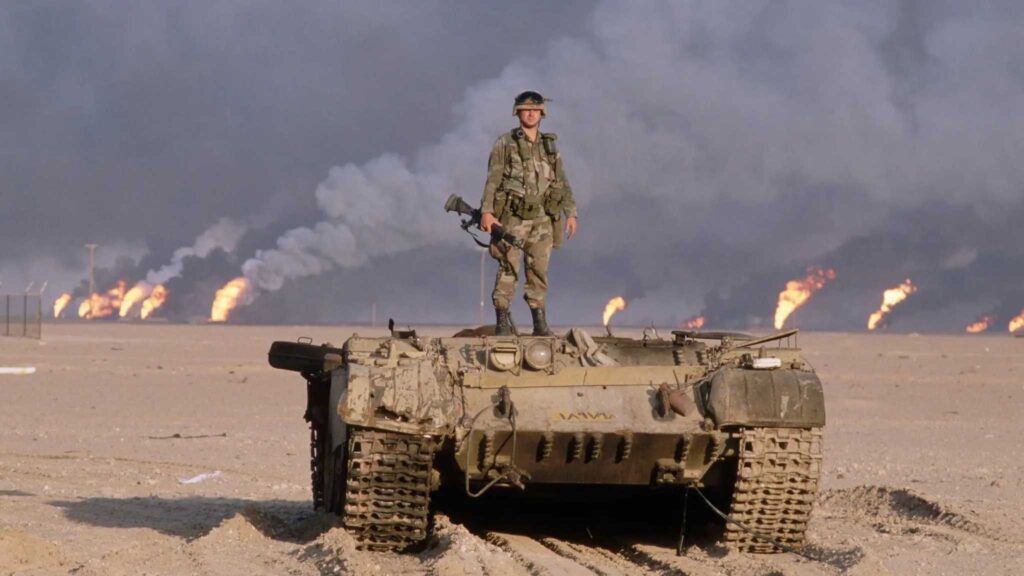
Eagle Troop was not alone. To their flanks, other troops of 2nd Cav were encountering similarly fierce resistance. G Troop in particular fought off repeated counterattacks by Iraqi tanks and BMPs emerging through the dust, calling on artillery and attack helicopters to help blunt the waves.
At the operational level, the regiment had stumbled into the point where those two Iraqi divisions overlapped; for a brief span that afternoon, Col. Don Holder’s dragoons were likely the only U.S. formation in the war that was both outnumbered and fully engaged across its front. But thermal sights and superior gunnery allowed them to see through the dust storm and kill at long range, even when the naked eye could barely make out silhouettes, a significant Coalition advantage.
The Battle of 73 Easting Destroyed Iraqi Defenses
The fighting that gives the battle its name coalesced along the 73 Easting line. As 2nd Cav’s squadrons advanced, they used the grid to report positions and control fires, but to the men on the ground, 73 Easting was just the place where the storm, the enemy’s defensive plan, and their own momentum collided.
For roughly 90 minutes, the regiment chewed through layer after layer of Iraqi armor, infantry, and artillery. Official Army histories credit the 2nd Cavalry with destroying at least 29 tanks and 24 armored personnel carriers and capturing about 1,300 prisoners in this engagement alone, while later tallies for the day suggest the regiment accounted for around 160 tanks, 300 other vehicles, and thousands of Iraqi casualties, at a cost of one Bradley destroyed and no Abrams lost.
By that evening, the fight that had begun as a routine covering-force advance actually wrecked two Iraqi divisions. The Republican Guard’s carefully prepared kill sacks were turned inside out by an enemy that could navigate off the roads, see through sand and darkness, and was willing to push beyond control lines to exploit surprise. Once the 2nd Armored Cavalry Regiment broke the Tawakalna and cracked open the seam at 73 Easting, the 1st Infantry Division passed through their lines and drove east into what remained of the Guard’s positions.
The drive toward Iraq’s positions began as a map sketch and became a giant armored scythe, swinging out into the western desert and then driving east into the Iraqi flank. The Marines and allied forces in Kuwait fixed Saddam’s army in place from the south, while VII Corps and its heavy divisions hooked around, hidden by distance, deception, and weather.
When the 2nd Armored Cavalry Regiment pushed ahead of the corps and made contact along the grid line labeled 73 Easting, it was the moment the “left hook” finally made contact with the Republican Guard’s face.
Iraqi units prepared for a frontal assault, but instead found themselves hit where their defenses were weakest. By fixing and shattering those forces at 73 Easting, 2nd Cav opened the door for the heavy divisions behind them to pour through and finish wrecking the Guard. All that remained was burning armor and white flags along a single, otherwise meaningless line on a desert map.
Read About Other Battlefield Chronicles
If you enjoyed learning the story about the Battle of 73 Easting, we invite you to read about other battlefield chronicles on our blog. You will also find military book reviews, veterans’ service reflections, famous military units and more on the TogetherWeServed.com blog. If you are a veteran, find your military buddies, view historic boot camp photos, build a printable military service plaque, and more on TogetherWeServed.com today.
SHARE:




0 Comments