

PRESERVING A MILITARY LEGACY FOR FUTURE GENERATIONS
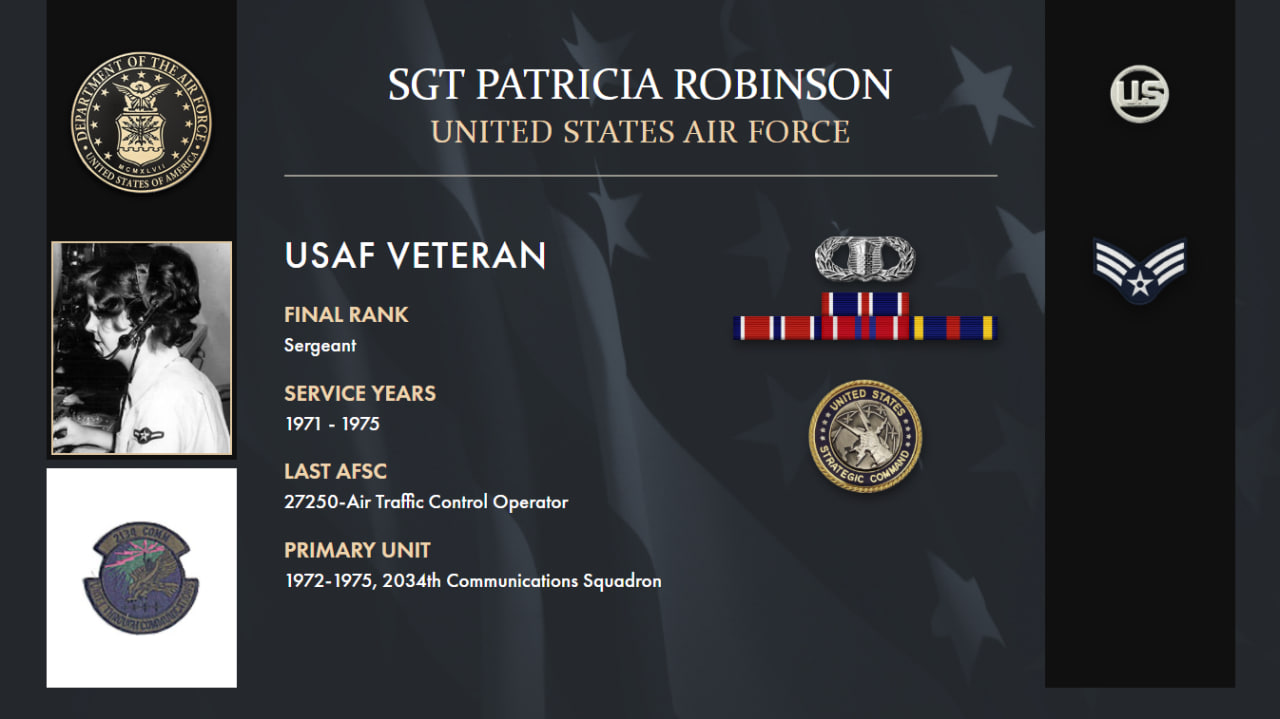
The following Reflections represents Sgt Patricia Robinson’s legacy of his military service from 1971 to 1975. If you are a Veteran, consider preserving a record of your own military service, including your memories and photographs, on Togetherweserved.com (TWS), the leading archive of living military history. The following Service Reflections is an easy-to-complete self-interview, located on your TWS Military Service Page, which enables you to remember key people and events from your military service and the impact they made on your life. Start recording your own Military Memories HERE.
Please describe who or what influenced your decision to join the Air Force.
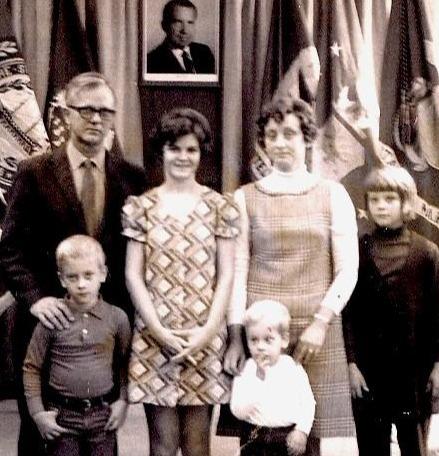
I graduated from high school in 1968 and worked full-time as a bookkeeper for a boot factory in New Hampshire. I didn’t make much money there and had little or no interest in the job or the factory. I was dating a man who was clearly not my intellectual equal, but he was the best I could find in small-town New Hampshire.
As always, I read many books and dreamed of a different life. How would I find that life? I had no money and played around so much in high school that my GPA was considerably below the level needed for college.
I remember thinking I might attend some technical school, but no field particularly appealed to me. On a whim, I went into an Air Force recruitment office in the nearest larger town. I think it was Manchester. The recruiter was welcoming, and I liked his natural, straightforward manner.
I met with him a few times and became increasingly intrigued by the idea of joining the Air Force. What would I do there? My recruiter (I regret that I’ve forgotten his name) told me about the various career fields that were open to women and the possible base locations. One incident happened that cemented my decision to join.
A gang of local veterans got together (probably over beers) and decided to beat up some anti-Vietnam demonstrators. This was in 1971. It turned out that one of this group was married to the boot factory executive secretary. I wasn’t in favor of the Vietnam War at the time, but I was disgusted by this behavior. Not long after that incident, I met with my recruiter. While I was there, a young man came into the office and told another recruiter that he wanted to “kill some gooks”. I had an urge to say, “Never mind,” and leave right then, but my recruiter assured me that an attitude like that was not acceptable in the Air Force. In fact, the other recruiter quickly and politely referred him to the Marine or Army recruiter next door. I was impressed with both recruiters’ ability to manage this incident, and I signed the enlistment papers that day.
Whether you were in the service for several years or as a career, please describe the direction or path you took. Where did you go to basic training, and what units, bases, or squadrons were you assigned to? What was your reason for leaving?
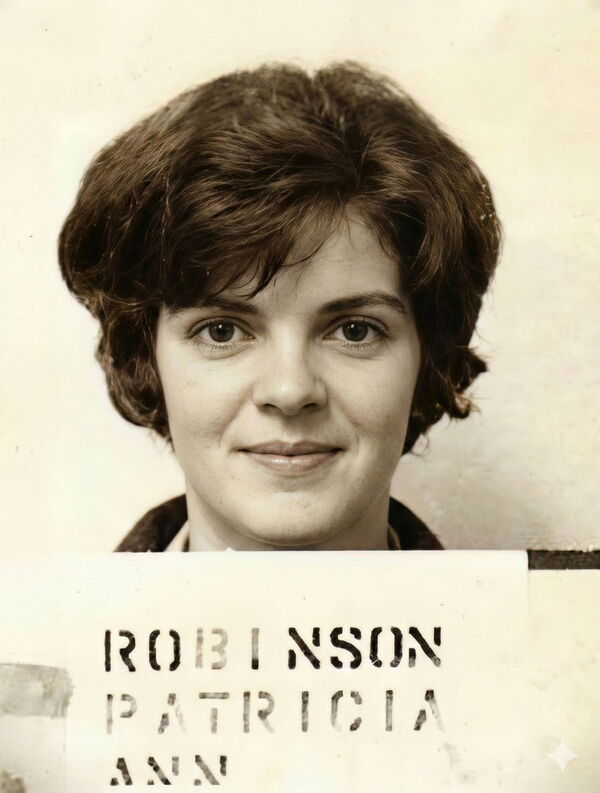
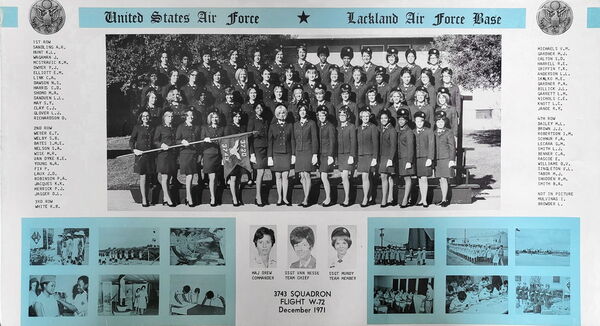
I arrived at Lackland Air Force Base in Texas on my birthday, October 25, 1971! It was my first air flight. I remember that it was the middle of the night, and no one appeared to be too concerned that all the new recruits arriving from various places were exhausted. I was so disoriented that I wondered what on earth I was doing in this gloomy cinder block room with all these strange people! We were all ushered into a bus that took us to the barracks, where we would spend the next 6 weeks. That period is a blur of calisthenics, classes, and marching to me now, except for one incident that has stayed with me over the years.
Like all new enlisted personnel, I had to stand in a long line to get required vaccinations, delivered by a gun that appeared capable of killing an elephant. Before it was my turn, I was asked if I was allergic to eggs. I said a doctor had told me I was, but I wasn’t sure he was right. That prompted someone to send me to a medical office for the shot (yellow fever, I believe it was). A nurse gave me that individual shot, and almost immediately, my arm swelled to twice its size and began to itch insanely! Shocked, I showed it to a nurse. While she treated me, I asked what would happen now. She said I would be sent home because they couldn’t use me if I couldn’t get that shot. I completely lost it. I never understood what it sounds like when someone is described as “wailing,” but I found out then. I was such a mess that they brought me in to see the doctor. When I calmed down enough to share what I had been told, he kindly reassured me that I would not be sent home. He told me the Air Force would not be able to send me to Africa or South America, but that was an unlikely destination anyway. My relief was profound, and nothing could have motivated me to succeed more than the devastation I had experienced at her words. I would make it. Six weeks was nothing.
I remember we all had to take turns getting up at 5 a.m. and going through the halls, yelling, “IT IS NOW OH 500. ALL AIRMEN WILL BE UP AND DRESSED, ALL BEDS WILL BE MADE, AND ALL ROOMS WILL BE IN INSPECTION ORDER NOW!!!”
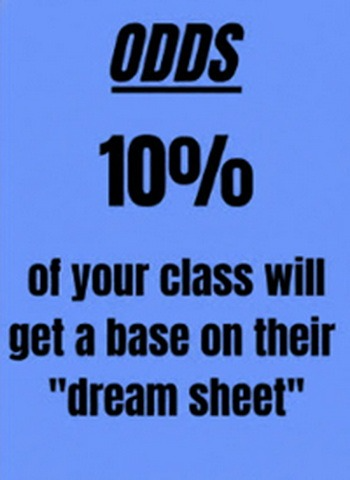
At some point in Basic Training, we had to fill out a “dream sheet” of our top three choices for desired bases and career fields. I remember hearing cynical people tell me before I enlisted that no one paid any attention to those preferences. The only cynical thought I had was that the people who didn’t get what they wanted weren’t really qualified! My first three career choices were Weather Observer, Air Traffic Controller, and some sort of Medical Service. My base preferences were Japan for overseas and California or Colorado for stateside.
I remember being delighted the day assignments were announced. My career field was to be an Air Traffic Controller, and my eventual assignment would be California after I completed tech school at Keesler AFB in Mississippi.
Tech school was outstanding! I was in a class with 6 men who all accepted me as one of the gang. We were treated like royalty at Keesler, as I recall. We never had to pull KP, never had to participate in parades, and had all weekends to ourselves. We went to New Orleans every chance we got (one of my classmates had a car, and we would cram ourselves in together!). We didn’t study much, but we were all smart enough to complete the training as intended, on time. I was sad to leave but looked forward to my permanent assignment at Mather AFB near Sacramento, California.
Actually, that assignment was a letdown after the novelty of Basic Training and Tech School. I came to realize I didn’t want to continue in the Air Traffic Control field. I sought a recruiting assignment in San Francisco, a city I loved passionately. No one could promise me that assignment, and I wouldn’t gamble on it. Instead, I received an “early out” so I could continue my college studies, which I had started while enlisted.
I was honorably discharged on August 22, 1975.
If you participated in any military operations, including combat, humanitarian and peacekeeping operations, please describe those which made a lasting impact on you and, if life-changing, in what way?
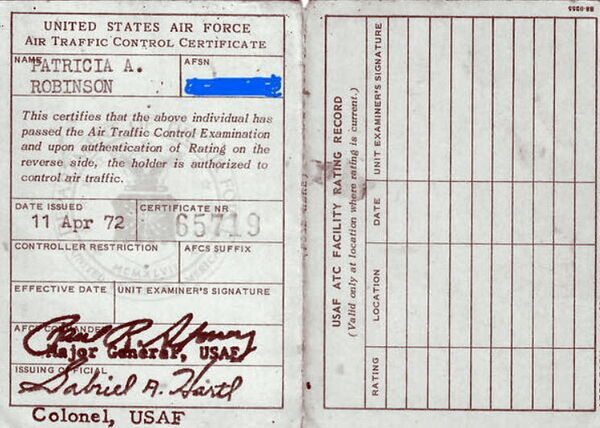
Being an Air Traffic Controller at a Strategic Air Command base during the Vietnam War meant that I had contributed to that conflict. I regret my part in sending fighters and B-52s to that country, where thousands more civilians and military personnel would die before the US finally exited the war on January 23, 1973. I didn’t become a strict pacifist after my discharge. Still, I did become a strong advocate of jus ad bellum (“right to go to war”) and jus in bello (“right conduct in war”), particularly after hearing about atrocities committed by our own troops against the Vietnamese.
Did you encounter a situation during your military service when you believed there was a possibility you might not survive? Please describe what happened and what was the outcome.
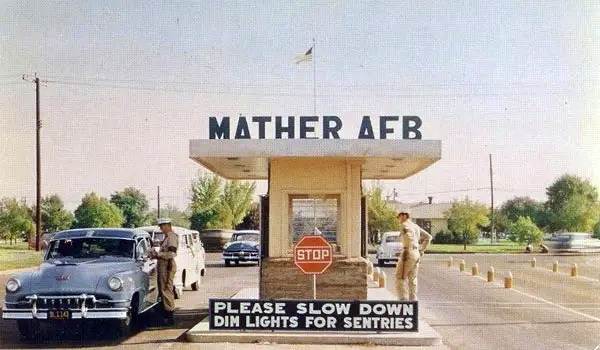
No. The only life-threatening experience I had was a major car accident during my first year at Mather AFB. I was grateful to the military medical professionals who provided me with care during that time.
Of all your duty stations or assignments, which one do you have the fondest memories of and why? Which was your least favorite?
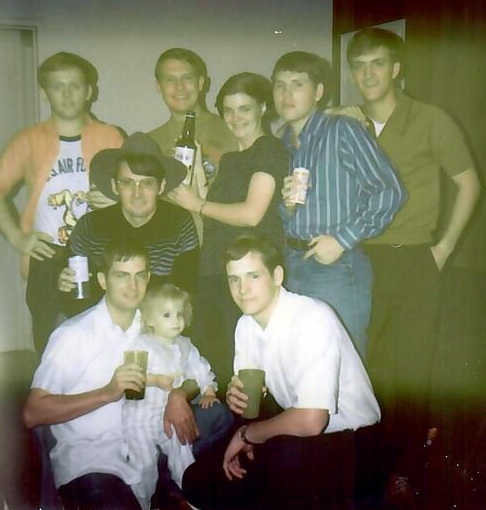
Keesler AFB, definitely. I made such good friends there and had an experience similar to living in a college dorm. Also, the food was excellent!
I guess I could say basic training at Lackland was my least favorite because I didn’t like the Texas weather. Also, I was often in a state of anxiety over the possibility that I wouldn’t “measure up” as an ideal Airman and might be sent home. For example, I remember making the mistake of stepping out of formation to retrieve our commander’s beret after a sudden gust of wind blew it off her head. She berated me for that. I was mortified and exercised great caution to behave like the soldier I imagined myself to be after that!
From your entire military service, describe any memories you still reflect on to this day.
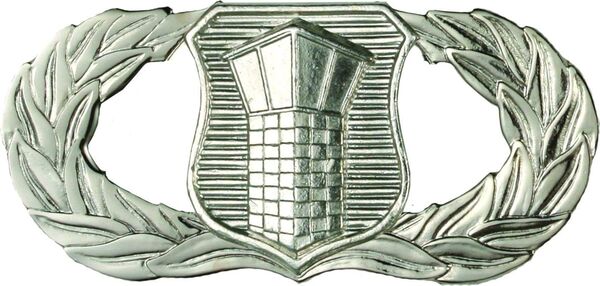
I remember that I was chosen to be the on-duty Air Traffic Controller when an inspection team flew in to check out our unit’s efficiency. The team and pilot put me through a number of contrived situations, such as an engine flameout, a missed approach, a broken navigation system, a simulated near miss, and other in-flight misfortunes. At the end of that, the pilot wrote up a wonderful report about the excellent Air Traffic Controller (Me!). The Base Commander read out the report at the following Base meeting and had me stand up while everyone applauded. I was thrilled, although a fellow Air Traffic Controller told me they should have made a bigger deal out of those kudos than they did. I understood his comments, but was still overcome by the praise and recognition I received that day.
What professional achievements are you most proud of from your military career?
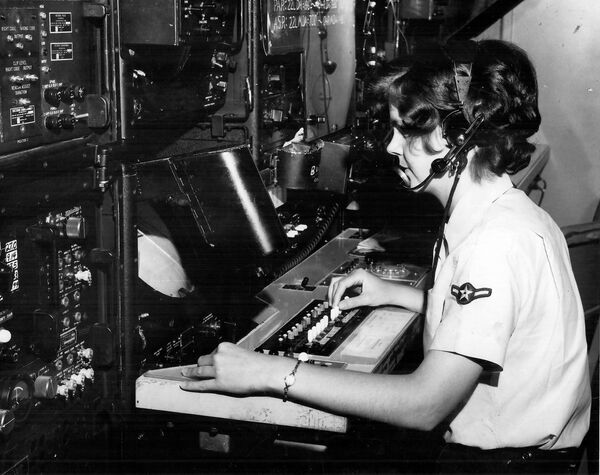
Getting my Air Traffic Controller license.
Of all the medals, awards, formal presentations, and qualification badges you received, or other memorabilia, which one is the most meaningful to you and why?
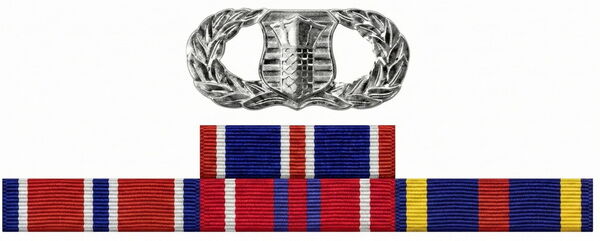
The one I described previously was from an Air Traffic inspection team.
Which individual(s) from your time in the military stand out as having the most positive impact on you and why?
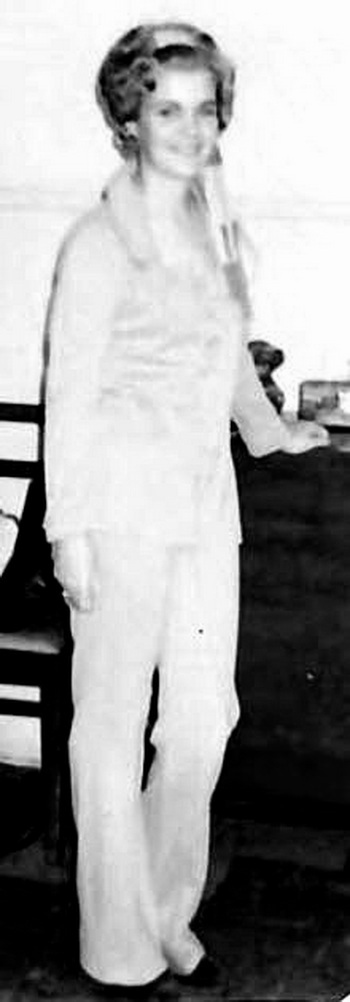
I can’t say there was just one. I found all the officers and enlisted supervisors to be professional and supportive. It left me with a very positive view of the Air Force. I have read that some women in the Air Force were discriminated against or suffered sexual harassment while on duty, but I never experienced any of that from anyone in my unit. A number of women, including me, reported that guards at the base gate would often delay our entrance with trivial questions or teasing comments.
It was annoying and had the potential to make us late for duty. We talked about that among ourselves and decided to report it to the female Wing commander. That minor harassment stopped immediately. I don’t think it was my imagination that the guards at the gate glowered at us while waving us through after that!
List the names of old friends you served with, at which locations, and recount what you remember most about them. Indicate those you are already in touch with and those you would like to make contact with.
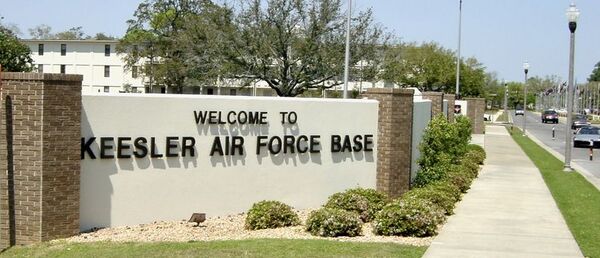
Honestly, I just can’t remember most of their names, except for a man named Randy, who was a buddy in my Air Traffic Control class and a former roommate at Keesler AFB: Julia Brown. Another Air Traffic Controller I knew well from Mather AFB was Sandy Hovekamp. I also dated a man I met at Mather AFB named Bruce Y. Brown (aka “BY”)
What profession did you follow after your military service, and what are you doing now? If you are currently serving, what is your present occupational specialty?
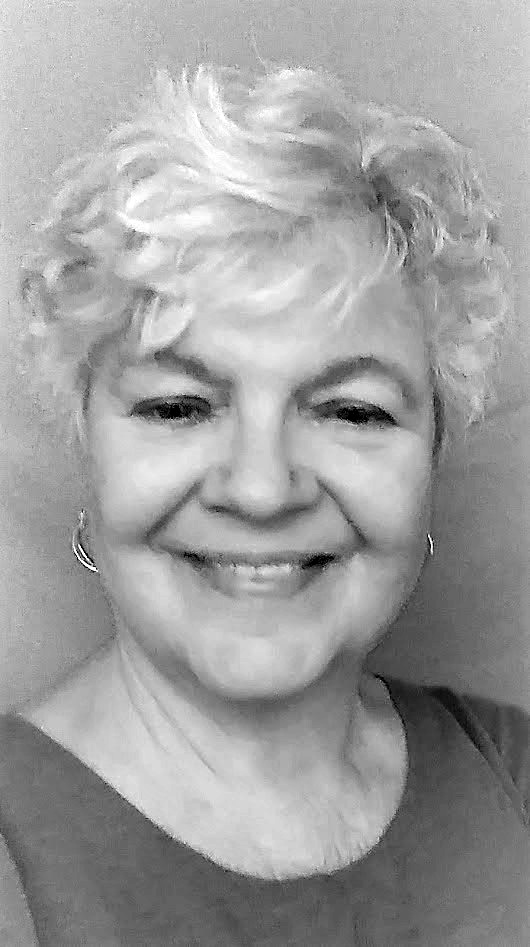
I went to college after military service (on the GI bill) and graduated with a BA in Environmental Sciences in 1979. I immediately went to work as a Transportation Planner for CalTrans until I resigned to take a position as a Health Educator. I left that job to become a City Planner, where I earned an MPA (also on the GI bill). I left that job to attend a seminary in Massachusetts. After graduating with an MDiv, I held various positions: Hospice Chaplain, Victim Advocate at a domestic abuse organization, Adjunct Philosophy professor, and Residential Manager for a private non-profit serving people with mental illnesses and substance abuse. Now, I am mostly retired, but I do work part-time with residents of a memory care unit in an Assisted Living Facility.
What military associations are you a member of, if any? What specific benefits do you derive from your memberships?
Just this one – Together We Served.
In what ways has serving in the military influenced the way you have approached your life and your career? What do you miss most about your time in the service?
It provided financial support when I went to college and helped me purchase two homes. It may also have helped me secure employment with Veterans Preference.
I don’t miss my time in the service at all, but I do have fond memories of it.
Based on your own experiences, what advice would you give to those who have recently joined the Air Force?
Make sure you get any promises in writing. If you have any serious complaints about a supervisor or anyone else, remember that all career fields have a wing commander. Seek out that person’s counsel.
In what ways has TogetherWeServed.com helped you remember your military service and the friends you served with?
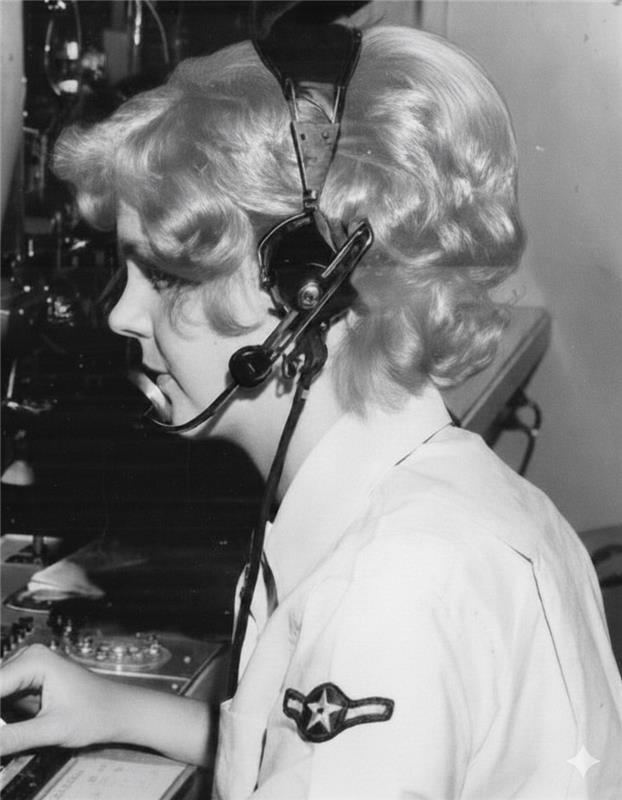
Writing all this out helped me relive the best parts of the military. I’ve enjoyed doing this.
PRESERVE YOUR OWN SERVICE MEMORIES!
Boot Camp, Units, Combat Operations
Join Togetherweserved.com to Create a Legacy of Your Service
U.S. Marine Corps, U.S. Navy, U.S. Air Force, U.S. Army, U.S. Coast Guard
SHARE:




0 Comments