

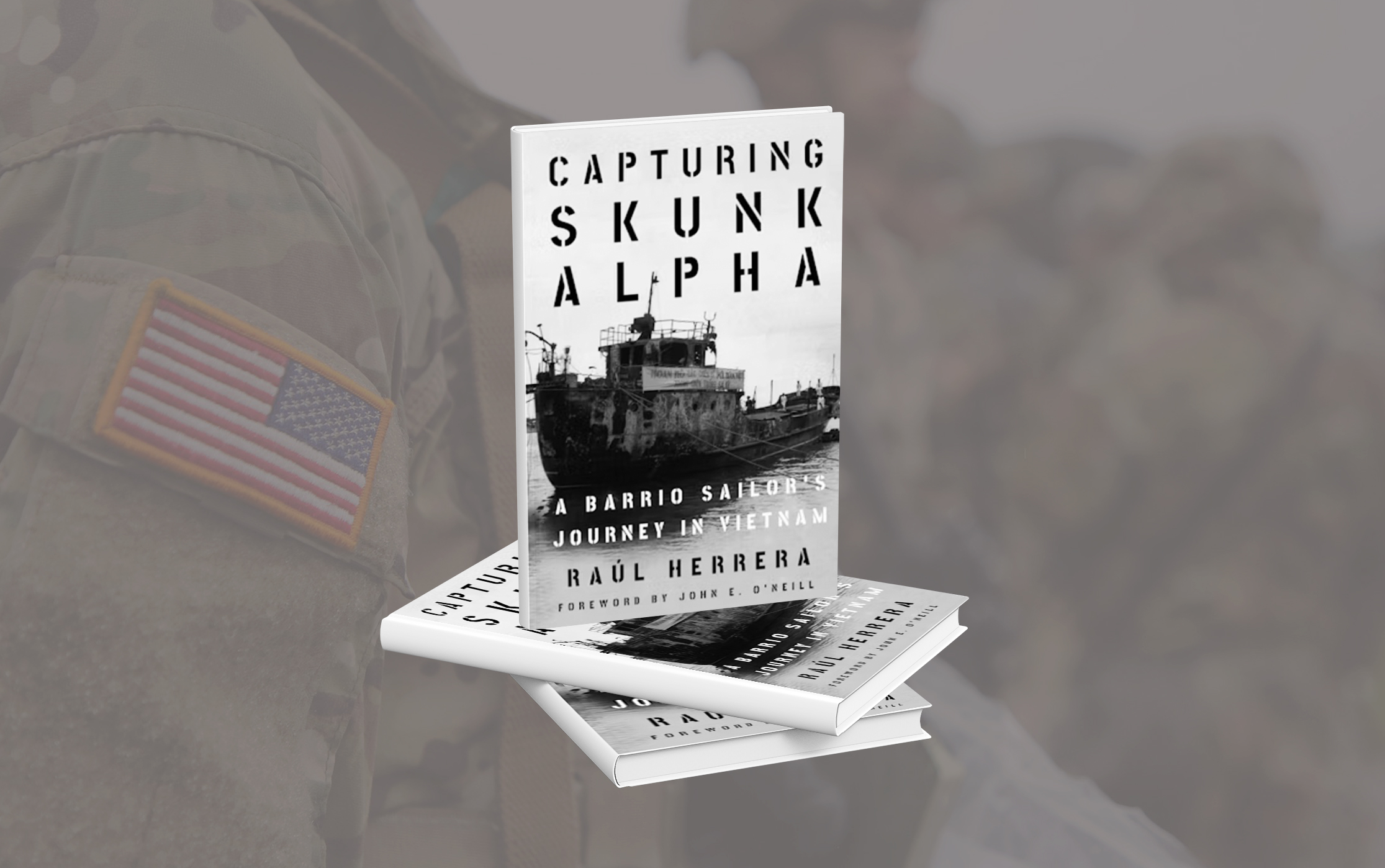
In “Capturing Skunk Alpha: A Barrio Sailor’s Journey in Vietnam,” author Raúl Herrera does something a lot of Vietnam books promise but very few deliver: he keeps you at “deck level” the whole time and still shows you the bigger war.
Capturing Skunk Alpha Brings the War Down to Deck Level
On the surface, it’s the story of one mission: the July 1967 hunt for a North Vietnamese resupply trawler, codenamed “Skunk Alpha,” and the small Swift Boat, PCF-79, that helped stop it cold off the coast of Quang Ngai. A Navy patrol plane spots a “suspicious trawler” heading toward a shoreline with no port as a four-ship task force forms inside the 12-mile limit. When warnings are ignored, PCF-79 is ordered to open fire, leading to a nighttime ship-to-ship brawl that ends with the trawler forced aground at the mouth of the Sa Ky River, more than 90 tons of ammunition and supplies denied to VC and NVA forces.
That alone would justify a book; it’s the kind of compact, kinetic action story that usually gets told from 30,000 feet. Herrera was there. He was the boat’s radioman and radar operator, manning the gear, listening to the coded calls, and watching the echoes on the scope as his boat closed to within a few dozen yards of an armed trawler in the dark. The book’s promise is that you will see this mission through his eyes, and on that count, it delivers.
Capturing Skunk Alpha is Shaped by a Barrio Sailor’s Past
But what makes “Capturing Skunk Alpha” more than just a single-operation war story is the other half of the subtitle: “A Barrio Sailor’s Journey in Vietnam.” Herrera isn’t a career officer writing from the wardroom. He grew up in a West Side barrio in San Antonio, 12 years of Catholic school, no money for college, and a recruiter’s promise of drafting school that evaporated as soon as he hit boot camp.
That background shapes the book in meaningful ways. The early chapters track his path from that neighborhood creek in San Antonio to the Navy training center in San Diego, to a brutal round of SERE training, complete with mock interrogations, cold-water torture, and the lesson that resisting to the bitter end can get you killed for real if you ever become a prisoner.
Those experiences don’t sit in the book as random war stories; they explain how a skinny, feisty Mexican-American kid who wanted to be an architect becomes the calm voice on the radio and the guy watching the radar when everything suddenly becomes very real.
Capturing Skunk Alpha Reveals the Swift Boat War
The Swift Boat material is where the book really earns its keep. Herrera walks the reader through how the U.S. ended up with 50-foot aluminum boats, initially designed for oil work in the Gulf of Mexico, suddenly repurposed as coastal gunboats under Operation Market Time. He explains what a PCF is, how a six-man crew actually lives on one, and what “brown-water navy” patrol work looks like when you’re hugging a hostile coast at night, checking junks, and hoping you’re right about who’s friendly and who isn’t.
Because the memoir grows out of his own oral history and years of talking with other Swift Boat veterans, the detail has that “only someone who was there would bother to remember this” texture: the nicknames, the ad-hoc uniform standards, the enlisted club called the Straw Elephant, where they tried to scrub 24 hours of fear off with bad music and beer. It’s not a generic Vietnam backdrop; it’s a very specific slice of the war that doesn’t usually get the spotlight.
When the book finally arrives at the Skunk Alpha mission, you understand exactly who is on that boat and how they got there. You know Boatswain’s Mate First Class Bobby Don Carver, the salty lead petty officer who “knights” Herrera with the barrio-coded nickname “Bean” and later hand-loads the 81mm mortar round that slams into the trawler’s pilothouse and forces it ashore. You also know that for Herrera, Carver’s story doesn’t end with that victorious night or the awards ceremony where the crew is decorated by Premier Nguyễn Cao Kỳ and Chief of State Nguyễn Văn Thiệu and feted for keeping those 90-plus tons of ammunition out of enemy hands.
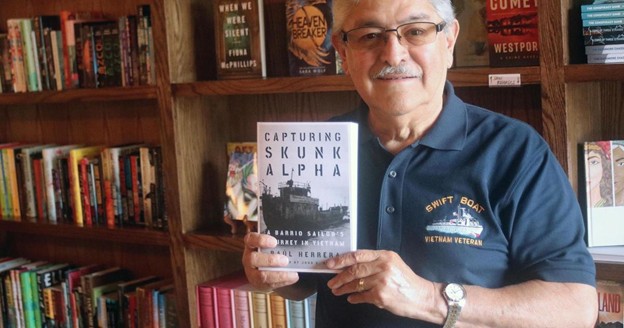
The book’s emotional core is pride—Herrera and his crew have every right to it—but there’s also a hard look at cost, survivor’s guilt, and what it means to carry one violent night, and one dead shipmate, around for decades.
Stylistically, Herrera has been writing and talking about this for a long time. He’s published in “Vietnam” and “Sea Classics,” and museums and oral-history projects have documented his story, and that polish shows. He knows how to explain technical things (radar echo clutter, gun mounts, patrol sectors) without losing a general reader, and he can switch from procedural detail to raw feeling in a sentence or two. The voice is conversational, sometimes wry, sometimes blunt, very much “senior vet telling you a sea story at a reunion” in the best way.
Are there trade-offs? Probably. Readers who want a high-level policy postmortem on Vietnam, or a neat “lessons learned” chapter on counterinsurgency, won’t find that here. Herrera’s focus never really leaves the deck plates, the coastline, and the small human circle of his crew and their war. Some civilians may also find the acronyms and place names a lot to track, though, to his credit, he usually gives enough context that you’re not lost for long.

But those caveats are minor next to what the book actually gives you: a rare, ground-truth look at the Navy‘s coastal war, told by someone who was literally on the radio net the night a steel-hulled trawler came out of the dark and ran into six very determined young men on a 50-foot boat.
Capturing Skunk Alpha Lingers Long after the Mission Ends
In the end, “Capturing Skunk Alpha” works on three levels at once: as an action story about a daring intercept mission, as a coming-of-age tale of a barrio kid who finds himself on the sharp edge of U.S. power, and as a veteran’s long, uneasy conversation with his own ghosts. It’s a valuable addition to the Vietnam shelf, especially if your picture of the war so far has been all rice paddies and helicopters and not nearly enough dangerous water under a thin aluminum hull.
Get it on Amazon in Kindle eReader or in paperback for $10.15, or purchase it directly from the author. It’s also available in MWR libraries.
Read About Other Book Reviews
If you enjoyed reading the review of ‘Capturing Skunk Alpha’, we invite you to read about other military book reviews on our blog. You will also find profiles in courage, veterans’ service reflections, famous military units and more on the TogetherWeServed.com blog. If you are a veteran, find your military buddies, view historic boot camp photos, build a printable military service plaque, and more on TogetherWeServed.com today.
SHARE:




Bean is a true character as guppy a fellow swifty of his 2nd crew who served with him during Tet he’s ok Guppy en2